Red flags when dating in your 60s are structural rather than personal: they describe how the contact behaves, not who the person claims to be. Whether someone talks too much about their grandchildren, replies at odd hours or has a terrible profile photo tells you almost nothing.
A structural flag is something about the shape of the contact itself — its speed, where it insists on happening, what it eventually asks for. It can be checked without knowing anything about the person, which is exactly why it is the useful kind.
The reporting routes in the section below were verified on the date shown above.
Which red flags matter most?
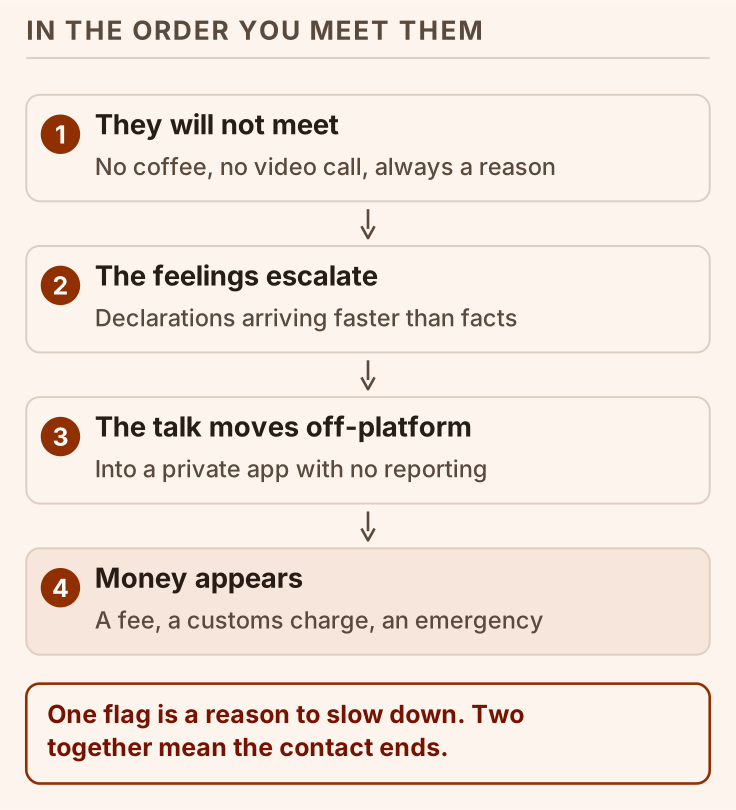
The four are: they will not meet in person or on video, the feelings escalate far too fast, the conversation is pushed off the platform straight away, and money appears. They are listed in the order you are likely to meet them, not in order of severity. Each one is worth acting on by itself; two together mean the contact ends.
They will not meet in person or on a video call
A person who lives in the next town and will not do a coffee on a Saturday morning has told you something. The excuses arrive pre-built: a contract overseas, an oil rig, a sick relative, a broken camera, a job that forbids video. Each is plausible alone. What is not plausible is the pattern of warm daily contact with zero face-to-face verification.
Set the test early and keep it cheap. A short video call in the first week costs nothing and settles the question of whether the photographs belong to the person typing.
The feelings arrive far too fast
Declarations of love in the first week, talk of moving in together in the second, a pet name before you have shared a meal. Fast attachment does happen between two real people, and it is not proof of anything by itself. What is diagnostic is speed combined with distance: intensity that grows while the person stays unreachable in every way that could be checked.
The professional version of this is called love bombing, and it works because it is pleasant. Being adored is not evidence.
They push the conversation off the platform immediately
“Let’s talk on WhatsApp” within an hour of matching is a working method, not a preference. The platform keeps a record, has a report button, and can ban an account. Off the platform, none of those exist, and neither does the evidence trail.
Moving to text or a phone call after a week or two of ordinary conversation is normal. Being moved in the first exchange, before anything has been established, is a step in someone’s process.
Money appears in any form
Not just a request for cash. A crisis that a small transfer would solve, an investment they want to share with you because they like you, a delivery held at customs, a phone bill, a plane ticket they will repay when they land, a gift card read out over the phone. Also the inverse: unusual interest in what you own, what you receive monthly, whether you have a mortgage.
There is no innocent version of this in the first months. A person you have not met does not need your account details, and a person you have met does not ask for them.
How does a romance scam actually run?
A romance scam is a sequence rather than a set of tricks, and the shape is easier to recognise than a list is to memorise. Contact opens warm and attentive. Intensity climbs quickly. The conversation moves off the platform. A reason emerges why meeting is impossible right now. Then a crisis arrives that money would solve. Then a second crisis, because the first payment marks the target rather than ending the story.
This is common enough to plan for rather than to panic about. Pew Research Center reported in 2023 that 39% of online daters ages 65 and older — that is, people in that age group who have used dating platforms, not all older adults — say they have encountered someone they thought was trying to scam them. That is an encounter rate, not a rate of loss; it is listed with its publisher, year and population on the statistics page. Encountering one is ordinary. Recognising the sequence early is what keeps it uneventful.
39%
Pew Research Center found that 39% of online daters ages 65 and older say they have encountered someone they thought was trying to scam them — how often people who use dating platforms run into an attempt, not how often anyone loses money.
Who these figures describe
- U.S. adults ages 65 and older who have used online dating platforms (base: online daters 50+, split at 65)
Source: Pew Research Center, 2023. See how we check numbers.
Show these numbers as a table
| Group | Value | Who it describes | Source |
|---|---|---|---|
| Online daters 65 and older | 39% | U.S. adults ages 65 and older who have used online dating platforms (base: online daters 50+, split at 65) | Pew Research Center, 2023 |
One variant deserves its own mention because it is aimed squarely at people in their 60s and 70s. Isolation means being talked, gradually, out of the company of people who would notice. For example, the contact begins to suggest that your daughter is jealous, that your friend is interfering, that what you two have is private. Secrecy is dressed up as intimacy. A person who wants you further from the people who know you is not building a relationship.
We do not give legal or financial advice, and nothing here is a substitute for it. What follows is the safety routine and the official reporting routes, nothing more.
What should you do if you think it is happening?
Stop contact, send nothing, keep the messages, and report it: to the platform first, then to the Federal Trade Commission and the FBI’s Internet Crime Complaint Center in the United States, or to the Canadian Anti-Fraud Centre in Canada. Do not tell the person you have worked it out.
In detail: do not send money, gift cards, crypto, bank details or documents, and do not accept money or parcels to forward. Warning the person only tells them which script failed. Keep the messages, profile screenshots and payment details; they are what a report is made of.
Then report it, in this order:
- The platform itself. Use its report and block functions. This is the step people skip, and it is the one that can take the account offline for everyone else.
- United States. The Federal Trade Commission takes reports at ReportFraud.ftc.gov, and the FBI’s Internet Crime Complaint Center at ic3.gov.
- Canada. The Canadian Anti-Fraud Centre takes reports online at reportcyberandfraud.canada.ca or on 1-888-495-8501, Monday to Friday, 10 am to 4:45 pm Eastern.
These routes were verified on September 8, 2026 and are re-checked at every review of this page. Reporting is worth doing even when nothing was lost: the report is about the account, not only about you.
Which red flags are not red flags?
Plenty of behaviour gets called a warning sign that is simply life at this age. Treating noise as signal costs you people worth meeting, and it also wears down the attention you need for the four that count.
| Often called a red flag | What it usually is |
|---|---|
| Slow replies, gaps of a day or two | A person with a life, grandchildren or a job. Consistency matters more than speed. |
| Few photos, or none showing the whole face clearly | Ordinary privacy, or ordinary discomfort with cameras. A video call resolves it quickly. |
| Living with an adult child, or a child living with them | A housing arrangement. It is not a character reference in either direction. |
| Not wanting to meet family or friends yet | Reasonable caution, especially early. It only becomes a flag if it turns into you hiding them. |
| Being clear that they do not want to remarry | Honesty about what is on offer, which is easier to work with than vagueness. |
| Not being on dating apps much | Normal. Pew Research Center reported in 2023 that 14% of U.S. adults in their 60s say they have ever used an online dating platform. |
The distinction that does the work: a real red flag concerns verification, escalation or money. Everything else on that list is preference, and preferences are negotiable.
How fast should things move?
Every one of the four flags is a pacing failure underneath. Scams need speed, because a slow relationship gets checked. Real attachment at this age can also move quickly, and that is not a problem in itself; what protects you is keeping verification in step with feeling.
People cite the 3-6-9 rule here: check in on a new relationship at three months, at six and at nine — first for consistency, then for how conflict and each other’s friends are handled, then for whether you both want the same thing. As a prompt to stop and look, it is useful. As protection, it is too slow: the four flags above show up in the first weeks, long before the first checkpoint.
Consider one rule instead, because it protects something specific: nothing irreversible happens before you have met in person twice. No money, no shared accounts, no keys, no giving up a lease. If someone finds that pace insulting, the pace has already done its job. The same pacing argument, written from each side of the pool, is on dating in your 60s as a man and as a woman. More on why relationships can move fast at this age, and why that is not automatically alarming, on falling in love at 60.
How do you meet safely in person?
Meeting is the goal, not the risk. The routine below is not about fear, it is about removing the few things that go wrong. Imagine the worst realistic version of a first meeting: it is a wasted hour, which the routine below keeps it to.
- Public and daytime, for the first two or three meetings. A café, a park, a gallery.
- Your own transport. Do not be collected from home, and do not give your address until you choose to.
- Tell one person where you are going, who with, and when you expect to be back. Share the profile link with them.
- Keep your own phone, charged, and keep it on you. Do not hand it over for someone to “add their number”.
- Leave when you want to. No explanation is owed, and no one worth meeting will demand one.
- Home stays private until you have decided it should not be, and so does your full name at work if that matters to you.
If you would rather do the first meeting in a structured setting where everyone leaves at the same time, speed dating over 60 solves that problem neatly.
Platforms differ a great deal in whether they verify identity and whether a person answers the phone. How we look at a platform, and what we refuse to say about one, is set out on how we review. Two of the five checks the low-tech entry index is built on bear directly on this page: whether you can complete sign-up in a desktop browser without a smartphone, and whether there is a phone number that a person picks up. The index publishes one row per platform with the date each check was run; no platform has been checked yet, so there is nothing in it to read. For the platform side of the question — where to meet people with verification — see the best dating sites for over 70.
For the wider picture of how dating at this age actually works, start at dating in your 60s; for what the research does and does not say about partnership after 60, see love after 60.