Last updated
About MeetOver60
Signed Neil Cowdray Editor · the family side
Most writing about dating after sixty either sells a platform or talks down to the reader. This site does neither: it answers the question that was actually asked, prints the date it checked anything it claims about a product, and says plainly where no published evidence exists.
Who writes this
I came to this subject from the next chair along. A parent of mine started dating again after a long marriage ended, asked me to sit with him while he filled in a sign-up form, and the two of us discovered together that almost nothing written about it was written for either of us. The pages aimed at him talked to him as though he were fragile. The pages aimed at me talked about him as though he were a risk to be managed.
What he actually wanted was narrow and practical. Whether the form would let him finish without a phone. What happened to his address once he typed it in. Whether the person messaging him at midnight was doing something recognisable or something unusual. Whether the quiet of a Tuesday was a reason to lower his standards. Not one of those questions needs a clinician to answer it, and not one of them was answered anywhere I looked.
So that is what this site is: the question as it was actually asked, answered in the first two sentences, with the date we checked it printed next to it and the place where the evidence runs out said out loud. I am not qualified to tell anybody how to live at an age I have not reached, and I would not trust a page that offered. What I can do is open the product, work through it, and write down exactly what happened.
What I arrived with
A kitchen table, a laptop, a half-finished sign-up form and a parent asking me questions I could not answer. Everything I could find was either a brochure for a platform or a warning aimed at his children. Nobody had simply opened the thing and written down what it does.
What changed the writing
Realising that most of what worried us was checkable rather than mysterious. Whether a browser sign-up completes. Whether a fee renews. Whether a pattern in a message is the ordinary one or the one that precedes a request for money. Checked on the live product, with the date attached, it stops being a matter of opinion. That is the whole editorial method here.
What these pages refuse
No scores out of five, no rankings built from figures the companies publish about themselves, and no odds of finding love: no national source measures them, and a page that prints a percentage there has invented it. No advice in the first person about dating at an age nobody here is, and nothing written as though the reader were being humoured.
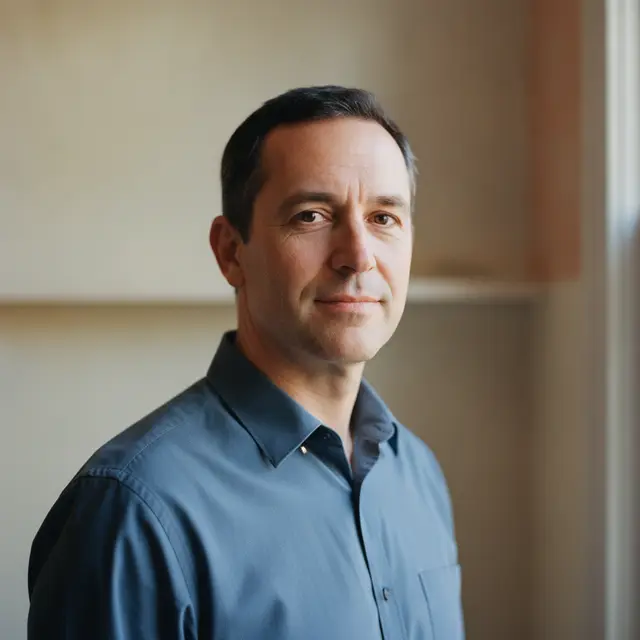
Neil Cowdray is a pen name, and it belongs to this site’s editorial team rather than to a biography you could look up. The name exists so that a page has somebody answerable for it, and it is not there to lend a page weight the text has not earned. There are no credentials behind it: nobody here is a therapist, a counsellor or a financial adviser, and no page is written as though it were. The portrait at the top of this page is not a photograph of a living person — it is an illustration generated with an AI tool, labelled as one wherever it appears, and it is there to give a byline a face rather than to tell you whose. What the name does not claim is your age: nobody writing here is in their sixties or seventies, no page speaks in the first person about dating at sixty-eight, and anything on this site that sounded like a contemporary talking would be a lie. Drafting is AI-assisted and human-edited, every figure is traced to a named publisher before it appears, and if a sentence here is wrong the fastest route to fixing it is hello@meetover60.com with the page address and the sentence you are disputing.
How the pages are made
Behind the byline is The MeetOver60 editors. There is no invented author and no borrowed credential. What we do is narrower and, we think, more useful: take the questions people actually ask before they join anything, answer them in the first two sentences, and say where the evidence runs out.
Every number is checked against a primary source before it is published — the list is on the sources page, together with what we rejected and why. Our process, sourcing standards, corrections policy, and how this site uses AI tools and labels its images are documented in the editorial policy, including a section on bylines and pen names.
What this site will not do
These are not promises. Each one is a rule the site is built to enforce, and the reason a page occasionally says less than it could.
- 01
No invented credentials, ever
Nobody here is a therapist, a counsellor, a lawyer or a financial adviser, and no page claims otherwise. There is no fabricated expert, no borrowed title, and no professional review we did not have.
- 02
Nobody here writes as your contemporary
The byline is a pen name for an editorial team, and that team is not the age this site is written for. No page says "I did this in my sixties", because none of us did. Where something is lived experience rather than a check we ran, the page says whose.
- 03
Every number traces to a primary source
Each figure names its publisher and the year in the same sentence, and links the study rather than an article about the study. Anything we could not read on the source itself was dropped, and the list of what we rejected is on the sources page.
- 04
Every platform claim carries the date we checked it
What we say a platform does is something we did on the live product ourselves, with the date attached. A check nobody has run yet says "not checked" rather than being filled in from a press page or another review site.
Corrections and contact
If we get something wrong we correct it on the page and say that we did. Email hello@meetover60.com or use the contact page. Corrections, sources we have missed and disagreements are all welcome — particularly from people the platforms we describe are actually built for.