Love at 60 is the ordinary experience of falling in love, arriving into a life that is already built — the same feeling as at 30, meeting a settled house, a formed week and a family that predates the other person by decades.
Falling in love refers to the preoccupation itself: the interest in small biographical detail, the reordering of a week around one person, the flat drop when a message goes unanswered. Nothing in that list has an age band, and the pages written for this reader usually leave it out.
What stays the same about falling in love at 60?
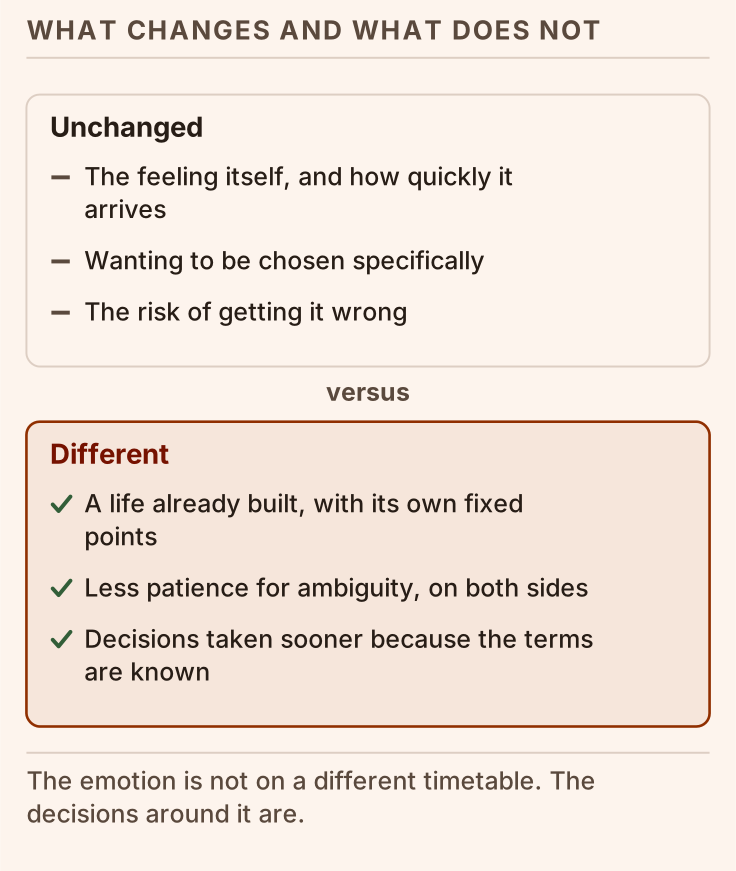
Almost all of it. Falling in love at 60 involves the same preoccupation, the same interest in small biographical detail, the same reordering of a week around one person, and the same discomfort when a message goes unanswered for a day. There is no separate later-life version of the feeling.
Most writing aimed at this age group frames it as different in kind — quieter, more companionable, less consuming. That framing tends to come from people who are not in it.
The small mechanics are unchanged too: rereading a message before sending it, checking the phone more often than you would admit, wanting to tell one particular friend before anyone else, and the flat drop of not knowing whether the other person feels the same. None of that has an age band, and it is the part most writing for this age group leaves out.
This page’s position is plain: the feeling is recognisably the one from thirty. The surprise is not that it is muted. The surprise is that it is not.
What is genuinely different at 60?
The differences are structural rather than emotional. Two established lives are meeting, not two forming ones, and each has a house, a calendar, a family and a set of routines that predate the other person by decades.
That produces four practical changes: disclosure comes earlier, logistics arrive sooner, tolerance for ambiguity drops, and both people are clearer about which parts of life are movable.
Disclosure means saying early what a week actually contains — who depends on you, what is already in the calendar, what happened in the last long relationship. It is the most visible of the four. Conversations that at 30 would have taken months — what a week actually looks like, who else depends on you, what happened in the last long relationship — often happen inside the first few meetings.
Logistics follow immediately behind. Two homes, two sets of friends and two established weeks have to be reconciled early, because there is no shared flat or shared job to do the reconciling by default. For example, a standing Thursday with grandchildren and a standing Thursday choir have to be discovered and worked around in week two rather than in month six. Couples who meet at this age tend to spend their first months negotiating geography rather than discovering it.
The tolerance point is the one people notice in themselves. Being kept guessing reads as inconvenience rather than intrigue, and most people stop responding to it much faster than they once did.
Why does love at 60 often move faster?
The pace comes from two things: a clearer sense of what you want, and an absence of the structural reasons to wait that shaped earlier relationships.
At 30, a slow start is often enforced from outside. Careers move people between cities, small children set the calendar, money is tight, and a shared decision waits on a promotion or a lease. Much of that machinery is gone by 60.
The internal reason matters more. After several decades of adult relationships, most people can tell within a few meetings whether someone is a fit, because they have a working reference set. Recognition is faster, so commitment is faster.
One published measure sits near this question without answering it. In 2022 the remarriage rate among U.S. adults aged 65 and older was 5.1 per 1,000 previously married adults — the only age group whose remarriage rate rose since 1990 — according to the National Center for Family and Marriage Research at Bowling Green State University. It counts weddings among people who were married before, so it leaves out cohabitation and every unmarried relationship, which at this age is most of them. It is not a rate of falling in love, and nobody publishes one.
Speed is not automatically a problem. It becomes one when it replaces information: agreeing to move house, merge routines or introduce families before either person has seen the other in a bad week. The pacing signals worth watching are set out in our guide to red flags when dating in your 60s.
Which worries about a new relationship at 60 are founded?
Three worries come up repeatedly. One is largely unfounded, one is real but manageable, and one is usually a misreading of the situation.
Am I too old for this to be taken seriously?
No, and the worry is generally about an audience that is not paying as much attention as you think. The people who treat a new relationship at 60 as a curiosity are rarely the ones close to it. Adults meeting adults is not a novelty act, and the relationship does not need anyone’s ratification to be real.
What will my adult children think?
This one is founded, and it is a timing problem more than an approval problem. Grown children usually react to being surprised rather than to the relationship itself, especially when they learn about it from a photograph or a third party.
Telling them early, plainly, and separately from any decision about living arrangements removes most of the friction. Their first reaction is often not their settled one, and a few weeks tends to do more than an argument. This page keeps to the social side of that conversation only; questions about property, wills or money belong with a professional, not with a dating site.
Am I starting over from nothing?
Usually not. Starting over implies an empty board, and most readers in this position have a home, friendships, a routine and a clear idea of what a good week contains. A new relationship is being added to a life, not built in place of one.
Consider what the adjustment actually looks like from inside: not an empty diary to fill, but a full one with a new standing appointment in it.
The adjustment that catches people out is smaller and more specific: two people with fully formed habits deciding whose version of a morning wins. That is a negotiation, not a reconstruction.
What if you do not want a relationship at all?
Not wanting this is a legitimate position and it does not need to be argued out of anyone. A reader who feels no pull toward a new relationship is not behind schedule, and nothing here assumes otherwise. It is also the majority position in the nearest age band anyone measures: three-quarters of single U.S. adults ages 65 and older are not looking for either a relationship or dates, according to Pew Research Center in 2020.
It helps to separate three answers that get treated as one. “Not this person” is a judgement about a candidate. “Not now” is a judgement about a period — a year with a house move, an illness in the family, or work that has not finished. “Not at all” is a settled preference. Only the first two are about timing, and none of the three owes anyone a justification, including the friend who keeps offering to introduce someone.
Imagine being asked which of the three you mean and finding that you do not know yet; that is a normal answer and it does not have to be resolved before Friday.
There is also a middle state that gets little airtime: wanting company without wanting a household, or wanting a person without wanting to be anyone’s project. Both are workable, and both are easier to hold once they are said out loud.
If the question underneath this page is really about solo life rather than romance, our page on being single at 60 covers what that looks like day to day, and dating in your 60s covers the mechanics if you decide you do want to start. If the barrier is the technology rather than the wish, our low-tech ways in list the routes that need no app at all.
This is an editorial page and not a memoir: we have not lived this, so there is no reader story here, no invented couple and no quote attributed to a person who does not exist. Questions about probability — how likely any of this is — are answered where the evidence lives, on the odds of finding love after 60.