Being single at 60 is a common, stable situation rather than a waiting room. Most pages on this subject treat it as a problem to be solved by dating; we treat it as a life that either works or does not, and dating as a separate decision you can make later or never.
Living alone is a household measure — who sleeps in the building — and it is not the same thing as being single. The two get quoted interchangeably, and almost every confusing statistic about this age group comes from that swap.
How common is being single at 60?
Pew Research Center reported in 2020 that 27% of U.S. adults ages 60 and older live alone, a higher share than in most of the world. That is the only clean 60-and-over figure on this page, and it counts households rather than relationships.
That distinction is the one that gets lost. Two families of figures get quoted about people this age: one counts who sleeps in the building, the other counts who is partnered. They are not versions of each other. The 65-and-older living-alone series, including the split between women and men, is published by Pew Research Center and covers 2023.
| Measure | Population | Figure | Source and year |
|---|---|---|---|
| Lives alone (household) | U.S. adults ages 60 and older | 27% | Pew Research Center, 2020 |
| Lives alone (household) | U.S. adults ages 65 and older | 26% | Pew Research Center, 2025 (2023 data) |
| Lives alone (household) | U.S. women ages 65 and older | 31% | Pew Research Center, 2025 (2023 data) |
| Lives alone (household) | U.S. men ages 65 and older | 19% | Pew Research Center, 2025 (2023 data) |
| Single: not married, not cohabiting, not in a committed relationship | U.S. adults ages 65 and older | 36% | Pew Research Center, 2020 |
| Unpartnered | U.S. women ages 65 and older | 49% | Pew Research Center, 2020 |
| Unpartnered | U.S. men ages 65 and older | 21% | Pew Research Center, 2020 |
| Not looking for a relationship or dates | single U.S. adults ages 65 and older | three-quarters | Pew Research Center, 2020 |
Every row above is reported on the population its publisher measured. Where the row says 65 and older, no 60-and-over version exists.
The household rows in more detail. Pew Research Center reported that 26% of U.S. adults ages 65 and older lived alone in 2023. Pew Research Center’s 2023 data also splits that by sex: 31% of women 65 and older lived alone, against 19% of men 65 and older.
Living alone at 65 and older is a minority arrangement for both sexes, and the gap between them is about twelve percentage points: women are the larger share, men the smaller one. Every bar counts households, not relationships.
Who these figures describe
- U.S. adults ages 65 and older, 2023
- U.S. women ages 65 and older, 2023
- U.S. men ages 65 and older, 2023
Source: Pew Research Center, 2025. See how we check numbers.
Show these numbers as a table
| Group | Value | Who it describes | Source |
|---|---|---|---|
| Adults 65 and older, 2023 | 26% | U.S. adults ages 65 and older, 2023 | Pew Research Center, 2025 |
| Women 65 and older, 2023 | 31% | U.S. women ages 65 and older, 2023 | Pew Research Center, 2025 |
| Men 65 and older, 2023 | 19% | U.S. men ages 65 and older, 2023 | Pew Research Center, 2025 |
On relationships, the measure changes completely. Pew Research Center reported in 2020 that 36% of U.S. adults ages 65 and older say they are single, defined as not married, not living with a partner and not in a committed romantic relationship.
A person can live alone and be in a relationship, or share a house and be unpartnered. Nobody publishes the relationship figure on a clean 60-and-over base, which is why those sentences say 65 and older and this one repeats it.
The split by sex is wide. Pew Research Center reported in 2020 that roughly half of U.S. women ages 65 and older are unpartnered (49%), compared with 21% of men the same age. If you are one of the single women over 60 who feels as though most of the women you know are in the same position, the measurement agrees with you.
One more figure changes how the rest of this page should be read. Pew Research Center reported in 2020 that three-quarters of single U.S. adults ages 65 and older are not looking for either a relationship or dates. For most people who are single at this age, it is a settled position rather than a transitional one.
Are solitude and loneliness the same thing?
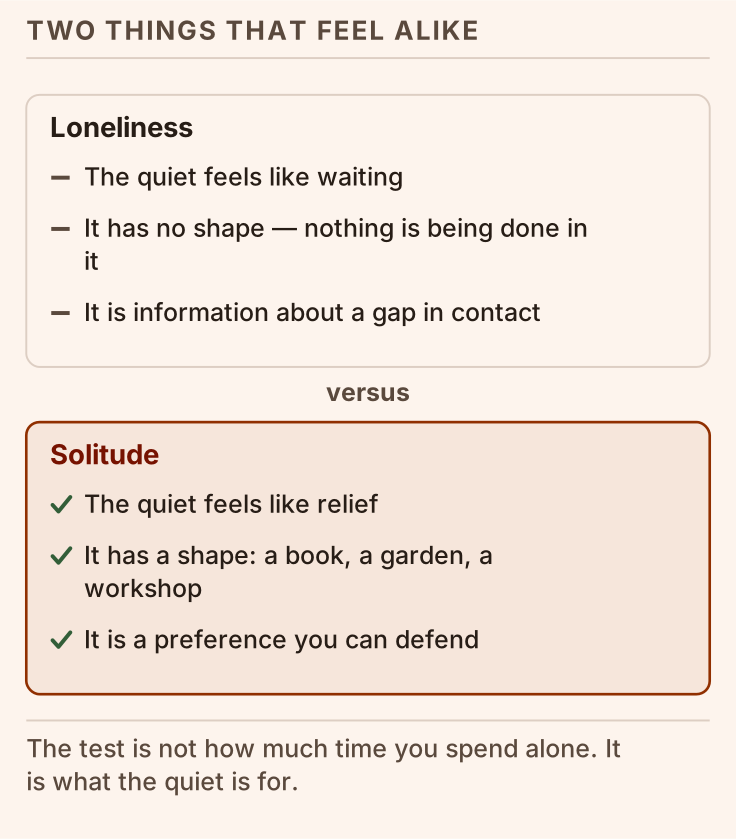
Solitude is a preference about how you spend time. Loneliness is a signal that the contact you are getting is below the contact you want. One is a choice you can defend; the other is information about a gap. They feel similar on a quiet Sunday and they are not the same condition.
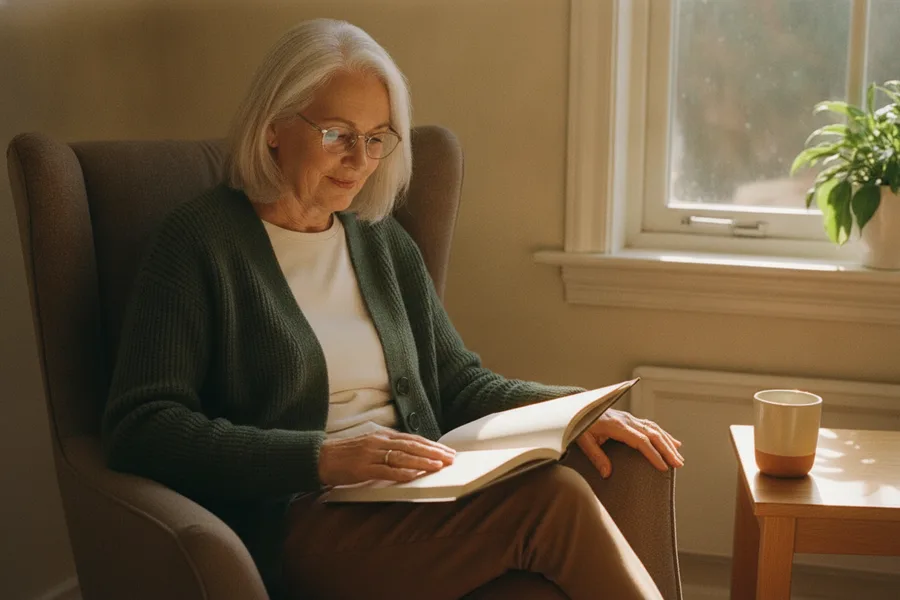
For example, two people can spend the identical Sunday afternoon in the identical armchair and be in completely different situations. The practical test is simple: does the quiet feel like relief or like waiting? Solitude has a shape — a book, a workshop, a garden, a morning you deliberately kept empty. Loneliness has none. It is the absence of something rather than the presence of anything.
Single by choice and single by circumstance are both real, and neither is the problem case
Some people arrived at solo life deliberately and would not trade it; others did not choose it and would take a partner tomorrow. Both are ordinary outcomes, and the practical advice on this page is the same for both.
Where they differ is in what a full week is for. Single by choice, the week protects something you already value. Single by circumstance, the week is what keeps the waiting from becoming the whole activity. We are not going to sort readers into the right box; the timetable works either way.
Why the distinction matters day to day
Solitude and loneliness respond to opposite treatments. Solitude gets ruined by well-meaning people filling your diary. Loneliness does not improve from being reframed as independence.
Someone who genuinely prefers their own company does not need to be recruited into a book club to prove they are fine. Someone who has been alone for four days and has stopped answering the phone is not exercising a preference.
What counts as enough contact
There is no correct amount, and comparing your week to someone else’s is not diagnostic. The useful question is whether the level of contact you have now is the level you would choose if you could set it.
If it is lower, look at structure before personality. Imagine the arithmetic of a working week that used to contain thirty short conversations by lunchtime, and then does not: the job that supplied them has gone, and nothing replaced it. That is a fixable arrangement, and it is fixed with a timetable more often than with a relationship.
We keep to the social side of the question. If low mood is persistent rather than situational, that is a conversation for a GP, not for a dating site, and we do not publish symptom lists or guidance on it.
Being alone and feeling alone can run in opposite directions
Living alone is a household arrangement. Loneliness is about contact. The Pew figures in the table above measure the first and say nothing about the second, and that is not a flaw in the data — they are answering a different question.
Consider two households on the same street: one person alone with four fixed appointments in the week, one couple with none. A full house is not the same as a full week. The useful audit is not who is in the building at 9pm. It is how many separate people you spoke to this week, and whether any of those exchanges were scheduled rather than accidental.
What makes solo life work?
Structure, contact, and one thing outside the house. The four below are what this page recommends, and they are practical rather than inspirational.
One recurring commitment at a fixed time. Weekly, same day, involving other people, and hard enough to skip that skipping is a decision. A choir, a class, a shift, a walking group, a standing lunch. The specific activity matters far less than the recurrence.
Two or three people on a predictable schedule. Not the whole address book. A short call on the same day each week outperforms a long one whenever it happens, because it survives a bad month.
A reason to leave the house before noon. The day tends to organise itself around whatever the first fixed point is. When the first fixed point is 6pm, the hours in front of it lose their edges.
Something in the house that is yours. A project with a next step. This is the part that separates a solo life from a paused one, and it is the part people underrate most.
None of this is inspirational and none of it requires enthusiasm. It is scaffolding, and scaffolding works whether or not you are in the mood for it.
The part nobody mentions: the second month
A new commitment can feel worthwhile in week one and pointless in week four, which is where it gets dropped. The month rule exists for that reason: judge it at the end, not in the middle, because the middle is where everything looks like a waste of an afternoon.
What if “retired and bored” is the real problem?
Being retired and single is two situations, not one, and the complaint that brings people to this page can be the first rather than the second. A week with nothing in it and a life with nobody in it feel identical from the inside, and they respond to entirely different things — a partner does not restore an imposed timetable, and a timetable does not supply company.
Work provides three things quietly: a schedule, a reason to be somewhere, and a supply of low-stakes conversation with people you did not choose. Retirement removes all three at once, and the first is the one that gets planned for.
The test is whether the emptiness has a shape. If the bad hours are specific — weekday afternoons, Sunday, the stretch between waking and lunch — the problem is structural, and structure fixes it. If the flatness is general and present even in company, that is a different question, and it is not a dating question.
The habit of an imposed week takes a while to wear off. Being bored and single at the same time does not mean one caused the other, and treating the boredom first is the cheaper experiment.
We do not write about pensions, retirement income or the various “rules” that circulate about them. That is outside what we cover, and a dating site is the wrong place to read about money.
What if you decide you do want to date?
That is a separate decision, taken from a settled position rather than out of a gap. The order matters: build the week first, then add dating to it, because a full week gives you something to write about and somewhere to be when a conversation goes nowhere.
The practical routes are the same whether you have been single for two years or twenty, and they are set out on singles dating over 60, which covers where people this age actually meet. If a platform is the route, the low-tech entry index is where we will publish one row per platform, with the date it was checked, against the five checks set out in how we review. No platform has been checked yet, so the index is currently empty.
For what a new relationship at this age is actually like — pace, disclosure, adult children — love at 60 covers the experience side. For the mechanics of profiles, first messages and first meetings, dating in your 60s is the working guide.
And if the underlying question is how likely any of this is, the honest answer and the figures that exist are on the odds of finding love after 60. There is no published probability of finding a partner at this age, and a site that gives you one made it up.
What does this page not claim?
Deciding to stay single is a legitimate outcome, and we did not write this page to talk anyone out of it. On Pew Research Center’s 2020 numbers, three-quarters of single U.S. adults ages 65 and older are not looking for either a relationship or dates, and that group is not waiting for the right article.
We also do not claim to know what being over 60 and alone feels like for you. There are no reader stories here, no invented couples, and no quotes attributed to people who do not exist. The figures above are reported with the exact populations their publishers measured, which is why some of them say 65 and older even on a page about being 60.