Checked: September 8, 2026.
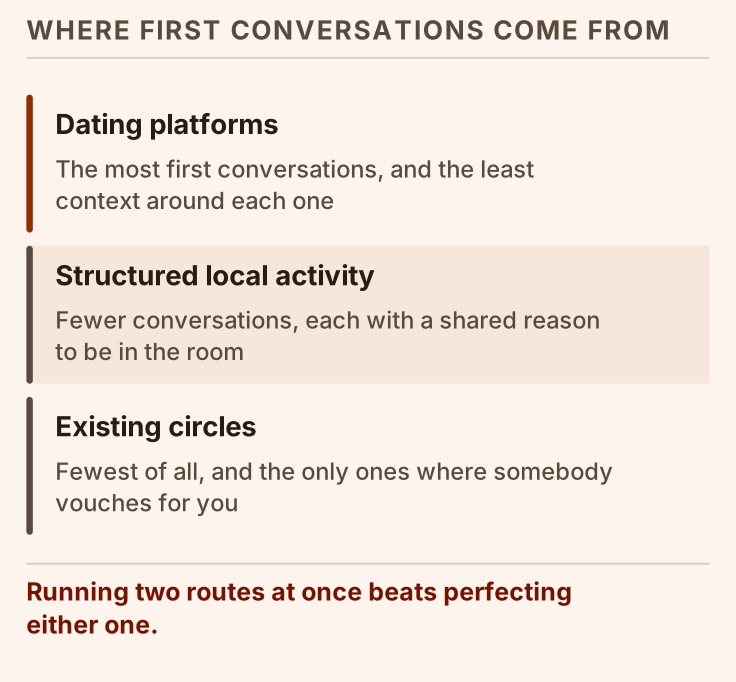
Singles dating over 60 runs through three routes and no fourth one: dating platforms, structured local activity, and existing social circles. Nearly every account of how a couple met at this age is one of the three, or a combination of two.
A route means a repeatable way of producing first conversations — not a venue and not a piece of advice. Routes are compared on what they produce and how fast, because that is the only comparison that survives contact with a real month.
Where do singles over 60 actually meet?
Singles dating over 60 runs through three routes and no fourth one: dating platforms, structured local activity, and existing social circles. Nearly every account of how a couple met at this age is one of the three, or a combination. The useful question is not which route is best, but which two you can sustain for three months.
Route 1 — dating platforms
A dating platform is a volume machine. It puts your profile in front of people you would never otherwise cross, and it removes the awkward part of establishing that someone is single and looking.
The pool is thinner than it is at 40, but it is not empty. According to Pew Research Center’s 2023 report on online dating at 50 and up, 14% of U.S. adults in their 60s say they have ever used an online dating platform — that is a share who have used one at some point, not a count of who is on tonight.
The cost of the volume is noise: unfinished profiles, people who stop replying, and a share of accounts that are not what they claim. That is a filtering problem, not a reason to skip the route.
Route 2 — structured local activity
Classes, clubs, choirs, walking groups, volunteering shifts, faith communities, civic and political groups. The defining feature is not the subject. It is that the same people return next week.
Repetition is the mechanism the second route runs on, doing the work a first message has to do on a platform: several low-stakes conversations with the same person before anyone has to decide anything. Nobody has been asked out, so nobody has been rejected. For example, four Tuesdays of talking to the same person after a class establishes more than four days of messaging does, and neither of you has had to declare anything.
The limitation is arithmetic. A weekly class contains very few singles, and you will not know which ones for a month.
Route 3 — existing circles
Being introduced through friends, former colleagues and family remains a live route at 60, and it is the one people leave switched off. It usually requires one uncomfortable sentence: telling two or three people directly that you are open to meeting someone, so they stop guessing.
The pool is tiny and slow. What arrives through it comes pre-vetted by someone who knows you both.
What does “dating over 60 near me” actually mean?
“Near me” at 60 means a wider radius than it did at 30, and that is a geography problem rather than a personal one. Density of single people your age falls with rurality, and the age band itself is dispersed — the people in it are not gathered in one part of town the way students or young professionals are.
A search like “single women over 60 near me” also runs into a product problem. Dating platforms are national products with a distance filter, not local services, so what you get back is not a local listing but whatever the national pool contains inside the radius you set.
Two numbers help set the frame, and neither is a dating statistic. Pew Research Center reported in 2020 that 27% of U.S. adults ages 60 and older live alone, a higher share than in most of the world. Living alone is a household measure, not a relationship status: plenty of those households contain someone partnered and plenty of shared households contain someone single.
27%
Pew Research Center reported in 2020 that 27% of U.S. adults ages 60 and older live alone — a household measure, so it says nothing about how many of them are single or looking.
Who these figures describe
- U.S. adults ages 60 and older (the only clean 60+ figure in this file)
Source: Pew Research Center, 2020. See how we check numbers.
Show these numbers as a table
| Group | Value | Who it describes | Source |
|---|---|---|---|
| Adults 60 and older | 27% | U.S. adults ages 60 and older (the only clean 60+ figure in this file) | Pew Research Center, 2020 |
The second is about intent. Pew Research Center reported in 2020 that three-quarters of single U.S. adults ages 65 and older are not looking for either a relationship or dates. The pool of people your age is not the pool of people looking, and confusing the two is how a reasonable search starts feeling like a rejection.
Practical consequence: set your platform radius wider than feels natural, usually to the nearest city rather than the nearest town, and accept that a first meeting may involve a drive. For in-person routes, do the opposite — pick something close enough that you will still go in February.
What does each route realistically produce?
Each route produces a different thing, and comparing them on the same measure is what makes people quit the wrong one.
| Route | What it produces | Realistic pace | Main cost |
|---|---|---|---|
| Dating platform | First conversations, in volume, with strangers | Fastest to a first message; slow to a first meeting | Noise, filtering, usually a subscription |
| Structured local activity | Few contacts, high context, no ambiguity about who someone is | Weeks before you know who is single | Attendance, in bad weather, for months |
| Existing circles | Rare introductions, pre-vetted | Unpredictable; can be years | One direct conversation with friends |
Checked: September 8, 2026. This table describes what each route does, not how likely it is to end in a relationship — no source publishes a partnering rate for people over 60, and we will not estimate one.
Consider what you are counting. Judge a platform on conversations that continue past three exchanges, not on matches. Judge an in-person activity on whether you would keep going if nobody there were single, because that is the version of it you can sustain.
Safety belongs in the same paragraph as volume. Pew Research Center reported in 2023 that 39% of online daters ages 65 and older say they have encountered someone they thought was trying to scam them. Encountering is not losing anything, and the pattern is recognisable early: read the warning signs before your first serious conversation, not after.
What if you are starting from a standing stop?
If you have not dated in decades and no route is currently running, do not start with a profile. Start with attendance.
Pick one recurring thing that puts you in a room with people every week, and go for a month before you do anything else. It rebuilds the ordinary conversational reflexes that a decade of not dating dulls, and it does it without anyone assessing you romantically.
Then add the platform. Doing them in this order means the profile gets written by someone who has been out of the house this week and has something specific to write about. Moving from single to dating covers the state you are starting from in more detail.
If a structured, in-person format appeals more than an app, speed dating over 60 is the one route that compresses many first conversations into an evening, though events at this age band are run locally and can be hard to find.
How should you choose a platform?
If a platform is where you are starting, choose it on what it requires of you rather than on its marketing. The four checks that matter over 60: does signup complete in a desktop browser, can you browse people before paying, is a support number published and answered, and can you cancel without phoning anyone.
You can run all four yourself before any card details are typed. How we review sets out what we check on a platform and what we refuse to publish about one; the low-tech entry index is where the entry-path checks are recorded. The rest of the over-60 platform writing sits on the dating sites for people over 60 hub, and for profiles, first messages and how first meetings usually go, dating in your 60s is the companion guide.
We do not rank platforms and we do not publish success rates, because no platform publishes verifiable ones.