Online dating for over 70 is a choice between a small number of platforms that behave very differently once you are inside them. This page gives you the five checks that decide whether the entry path is usable at all, and it names no platform we have not opened and dated ourselves.
The entry path is everything between the home page and your first message: sign-up, browsing, support, text size and cancellation. It is the part that actually stops people in this age band, and it is the only part a reader can verify without paying anything.
Pew Research Center reported in 2023 that 12% of U.S. adults in their 70s and older say they have ever used an online dating platform. That is a measure of having tried it, not of having met anyone, which is roughly the right expectation to arrive with.
How did we choose these?
A platform qualifies for this page on two grounds: real density of people aged 65 and older, and a low-tech entry path. Density means how many active profiles sit inside a radius you would actually drive, and it decides whether there is anyone to talk to at all.
Density is also the reason the national picture is a poor guide to your county. In 2022, 57.4% of U.S. adults aged 65 and older were currently married, according to the National Center for Family and Marriage Research at Bowling Green State University — a marriage-certificate count, in which someone living with an unmarried partner is recorded as not married. It sets the scale of the band; it says nothing about how many of the rest are inside your radius, and no platform publishes that either. The entry path decides whether you can get in without borrowing a grandchild’s phone.
The low-tech entry path is defined by five checks, published on the how we review page and used as the columns of the low-tech entry index. The index publishes one row per platform with the date it was checked; no platform has been checked yet, so the index is empty and this page names none. The standing rules are on the editorial policy page.
Anything we cannot open and check ourselves will not appear here. That rules out platforms with no public web version, and platforms that show no profile at all until a card is on file.
What are the five checks?
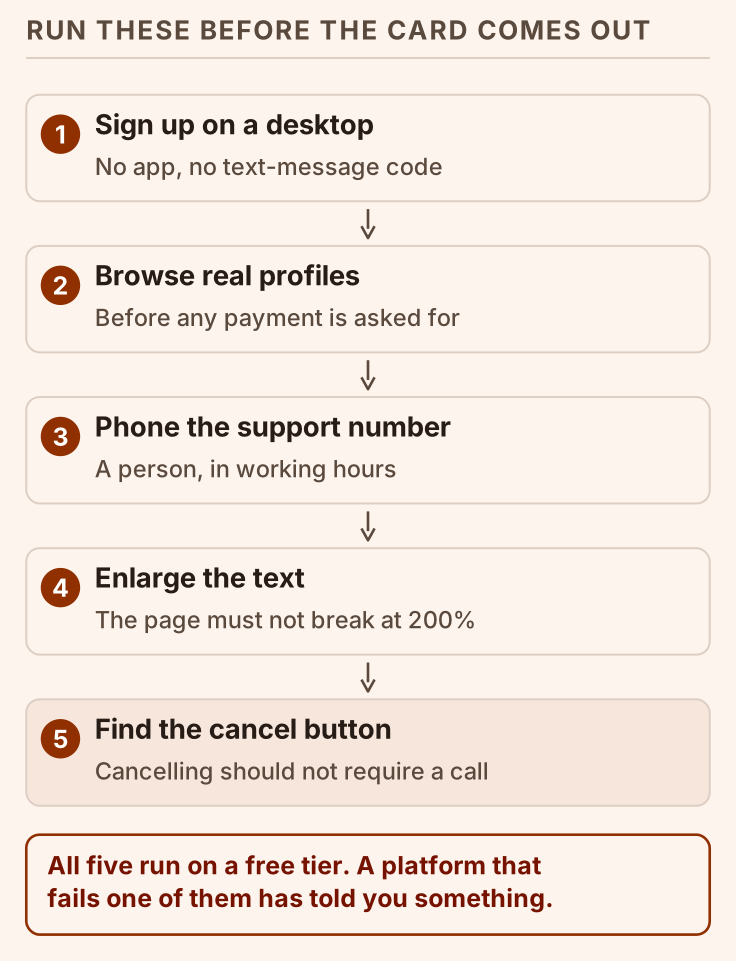
The table below is the test, not a scoreboard. Run these five rows against any over 70 dating website before you enter a payment method, and treat each failure as a reason to look elsewhere rather than as points off a score. There is no threshold and no formula; the check that matters is the one you personally cannot work around.
| Check | What passes | What a failure looks like | Why it matters at 70+ |
|---|---|---|---|
| Desktop sign-up, no phone | You complete sign-up in a desktop browser, without a smartphone | It stops to demand an app, a text-message code, or a camera | A laptop has bigger type, a real keyboard and no app-store account |
| Browse before paying | A free account shows whole profiles, so you can see real people before handing over money | Blurred photos, or a wall asking for a card | You learn whether anyone is nearby before spending |
| A person answers | There is a phone number on the platform’s own site, and a person picks it up in the stated hours | Chatbot only, or a form with no stated reply time | Billing and cancellation problems are phone problems |
| Text enlarges cleanly | Text gets bigger in the browser with nothing overlapping, disappearing off the side, or becoming unclickable | Buttons slide under each other, or the message box vanishes | Reading a profile should not require leaning into the screen |
| Cancel without calling | A cancel path in account settings, with price and renewal terms stated before checkout | Cancellation routes you to a phone call or a retention chat; price appears only after card entry | Auto-renewal after a trial is a routine billing dispute, and the exit should not need a phone call |
The wording of those five checks is fixed on how we review and is not adjusted per page. Prices move faster than features do, so treat any price you read anywhere as stale until you have seen it on the checkout screen yourself.
Which platforms are named here, and when?
Nothing yet. No live check has been completed on any named platform for the over-70 slice, so this page names none. Recommending a platform we have not opened would be the one thing this site exists to avoid.
When entries appear, each will follow the same skeleton: who it fits, the entry path, the one thing most likely to annoy a reader in their 70s, and the exit path, meaning how to cancel and whether that can be done without a phone call. Every line will carry the date it was observed and the page it was observed on, and the same rows will appear in the low-tech entry index as they land.
A review assembled from other reviews ages invisibly. A dated one tells you when to stop trusting it, which is why an empty section ships here instead of a borrowed one.
Are there genuinely free options?
Free registration is offered on many over 70 dating sites. Free replying is a different matter. The usual structure lets you create an account, complete a profile and browse who is within your chosen distance without paying, and puts the paywall at the moment you try to answer a message someone sent you.
That structure is still useful. For example, a fortnight of unpaid browsing tells you how many plausible people sit inside a radius you would actually drive, which is the one number a subscription cannot change. Spend the unpaid days on it, then decide. A platform with a thin local pool is not worth a subscription no matter how good the free tier feels.
Free over 70 dating sites in the strict sense — no paywall anywhere — are hard to find, and the genuinely free routes are not platforms at all: community noticeboards, interest groups and event listings. They produce fewer first conversations per hour and better odds of meeting someone who lives close enough to see twice.
Two positions we hold at once
One position we hold: pay early. A single subscription used seriously for two months, on one platform that passes all five checks, beats a year of free accounts spread across four sites, and the paywall is where the less serious accounts stop.
The counter-position we also hold: exhaust the free tier first. Until you have seen the local pool unpaid, you are buying a number you have not looked at, and the renewal date arrives faster than the second date does.
Both are defensible, and this page does not pretend to settle it. The point they share is that only one platform gets your money at a time.
What does the distance filter actually do?
The distance filter measures where a profile says it is, not where the person spends their week. Consider setting it to the radius you would genuinely drive for a coffee, then look at how many active profiles remain. That number, not the platform’s national membership, is the pool you are joining.
Imagine the same platform in a city and in a rural county: identical product, entirely different answer. Where the count inside that radius is small, no subscription fixes it, and the in-person route through the hub page for dating over 70 will produce more first meetings than any platform will.
How common are scam attempts at this age?
Pew Research Center found in 2023 that 39% of online daters ages 65 and older say they have encountered someone they thought was trying to scam them. That is an encounter rate among people who use these platforms, not a loss rate, and it is a reason to know the pattern rather than to stay away. The full treatment, with where to report, is on red flags when dating in your 60s.
What if you are in your 60s rather than your 70s?
The five checks are the same, and the shortlist is wider, because more platforms have usable density in that age band. Pew Research Center reported in 2023 that 14% of U.S. adults in their 60s say they have ever used an online dating platform, compared with 12% of those in their 70s and older. The over-60 comparison lives on dating sites for those over 60, and the pace-and-expectations material is on dating at 65.
Pew Research Center found that only a small minority of Americans in their 60s, and a slightly smaller minority of those in their 70s and older, have ever used an online dating platform at all — this counts having tried one, not having met anyone through it.
Who these figures describe
- U.S. adults in their 60s
- U.S. adults in their 70s and older (Pew's published band: 'those in their 70s and older')
Source: Pew Research Center, 2023. See how we check numbers.
Show these numbers as a table
| Group | Value | Who it describes | Source |
|---|---|---|---|
| Adults in their 60s | 14% | U.S. adults in their 60s | Pew Research Center, 2023 |
| Adults in their 70s and older | 12% | U.S. adults in their 70s and older (Pew's published band: 'those in their 70s and older') | Pew Research Center, 2023 |
What did we leave out, and why?
No star ratings. A single score compresses separate checks into one number and hides which one failed, and the one that failed is the one you care about.
No member counts or success rates. Platforms publish those about themselves, no two count the same way, and none can be verified from outside. They are not printed here.
No platform nobody here has opened, and no complaint sourced from another review site. A claim with no observation date attached to it does not belong on this page.
How this page is funded: it carries no outbound platform links at present. If we add them, some may earn a commission, and payment will not change the checks, the table, or the order of anything on this page. The rules are on the editorial policy page.
One next step: run the five checks yourself on the platform you were already considering, before you enter a card. If it fails on cancellation or on phone support, the trial month is not the cheap experiment it looks like.