Checked: September 8, 2026.
Dating at 65 is the ordinary business of meeting someone, arriving with a specific problem attached: not whether it is possible, but where to put the first hour.
The pool at this age means the people in the band who are unpartnered and looking, which is a much smaller group than the band itself — and confusing the two is what makes a slow first month feel like a verdict. This page covers what actually differs at this age, where people are meeting, what a realistic first month looks like, and what goes wrong in the first few weeks. We compare platforms elsewhere — see dating over 70 and the platform reviews.
What is actually different about dating at 65?
Three things change at 65, and none of them is about you: time, geography, and the composition of the people around you. The calendar is usually more open than the calendars of the people you are meeting, the search radius is narrower than it was at 50, and the age band around you is not shaped the way a dating profile implies.
That last point is worth stating with numbers rather than atmosphere. In 2022, 57.4% of U.S. adults aged 65 and older were currently married, according to the National Center for Family and Marriage Research at Bowling Green State University. That is a marriage-certificate measure and nothing more.
57.4%
In 2022, 57.4% of U.S. adults aged 65 and older were currently married, a marital-status count in which people living with an unmarried partner are recorded as not married.
Who these figures describe
- U.S. adults aged 65 and older, 2022 (marital status only — cohabiting and unmarried partners are counted as not married)
Source: The National Center for Family and Marriage Research at Bowling Green State University, 2024. See how we check numbers.
Show these numbers as a table
| Group | Value | Who it describes | Source |
|---|---|---|---|
| Adults 65 and older, 2022 | 57.4% | U.S. adults aged 65 and older, 2022 (marital status only — cohabiting and unmarried partners are counted as not married) | The National Center for Family and Marriage Research at Bowling Green State University, 2024 |
Partnership is measured differently. Pew Research Center reported in 2020 that 36% of U.S. adults ages 65 and older say they are single — meaning not married, not living with a partner and not in a committed romantic relationship. The two figures answer different questions, and neither is the complement of the other.
The number that changes the week is smaller still: Pew Research Center found in 2020 that three-quarters of single U.S. adults ages 65 and older are not looking for either a relationship or dates. Being available and being interested are separate states, and that Pew figure measures the second one.
There is also a settled-routine difference. At 50, dating tends to get built around a schedule of work and family that is still moving. Where a routine is already fixed at 65 — a standing Tuesday, a house, a town you do not intend to leave — dating has to fit around it rather than reshape it. That makes early conversations practical fast, and it makes vagueness about logistics a signal rather than shyness.
Two editorial readings of the same moment sit behind everything below, and we hold both. One reads 65 as a restart: the constraints that set the terms last time — a job, children at home, someone else’s calendar — are gone, and what you are choosing now you are choosing on your own terms. The other reads it as a continuation: the same person, the same taste in people, the same tolerance for being messed about, with more evidence to draw on. The restart reading gets you to open an account. The continuation reading is what stops you treating a bad first month as a verdict on yourself.
Where are people at 65 actually meeting?
There are three routes: online platforms, structured in-person settings with a repeat schedule, and existing networks — friends, former colleagues, neighbors who introduce people. Nothing stops you running two at once, and the fourth week of the plan below assumes you might.
Online is the route that reaches past the people you already know, and it is a minority route. Pew Research Center reported in 2023 that 14% of U.S. adults in their 60s say they have ever used an online dating platform. “Ever used” is the exact measure — not currently active, and not “met a partner there”.
A structured setting is any arrangement where the same faces come back on a schedule, and it works for a reason that has nothing to do with romance: repeat contact without either person having to declare an intention. Classes with a term, volunteering with a rota, choirs, walking groups, a bridge night. For example, six weeks of a Tuesday class produces six unremarkable conversations with the same person, which is more than any first message can buy. A one-off event does not do this; a weekly commitment does.
Consider the third route before dismissing it. Existing networks cost nothing, and the thing that stops people using them is that asking feels like an announcement. It does not have to be. “If you meet someone you think I would like, say so” is a full sentence and it stays open for years.
Before joining any platform, three of the five checks behind our index are worth running yourself on the live product: can you complete sign-up in a desktop browser, without a smartphone? Can you see real profiles before you hand over money? Can a paid subscription be cancelled without phoning anyone? The low-tech entry index is where those checks get published as they are run — no platform has been checked yet — and how we review sets out how each one is carried out.
What does a realistic first month look like?
A first month at 65 is a sequence, not a promise. Four weeks is long enough to find out whether the route you chose produces meetings at all, and short enough that you have not spent a season on messaging.
| Week | What happens | What to judge it on |
|---|---|---|
| 1 | Profile written, one platform only, photos from this year | Whether the profile says where you live and what a normal week looks like |
| 2 | First exchanges — aim for a call or a meeting by the third exchange | How many conversations move toward a plan rather than circling |
| 3 | First in-person meetings, public place, one hour, daytime | Whether you left wanting a second hour |
| 4 | Review: keep the route, change the route, or add a second one | Number of actual meetings, not number of messages |
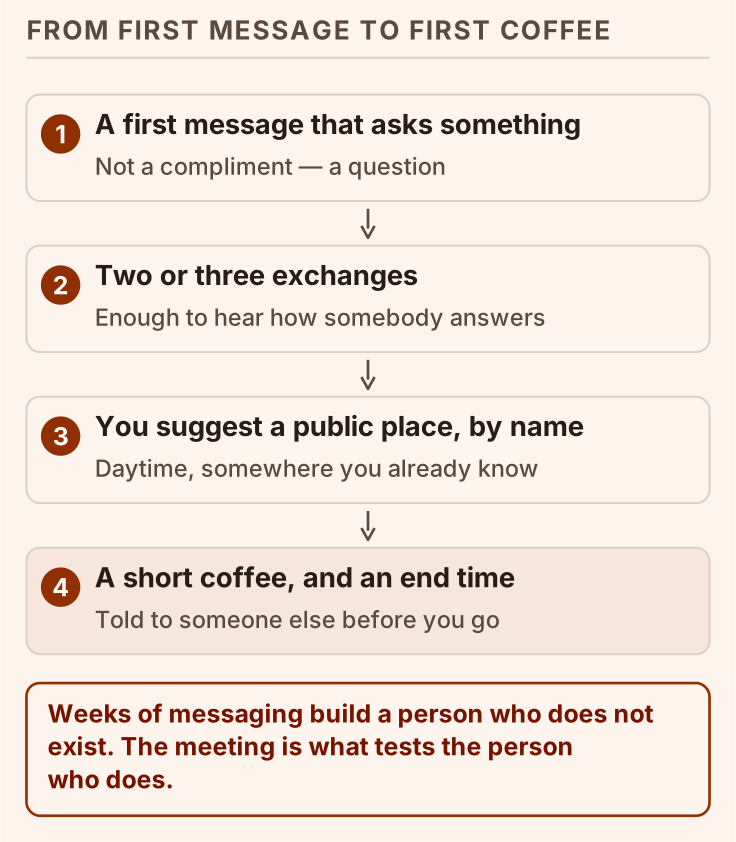
Two rules make the month work. Keep the first meeting to about an hour in a public place, and treat it as a conversation rather than a decision — you are finding out whether there is a second conversation, nothing more. And add a second route before concluding the first one failed; one month on one platform is a sample of one.
What the month is not is a test of you. It is a test of a route. A profile that produces no meetings in four weeks is evidence about where you looked, not about who you are, and the fix is usually the route or the radius rather than the wording.
What tends to go wrong in the first few weeks?
The early failures worth naming are pacing failures rather than compatibility failures. Long message threads that never turn into a meeting, a sudden move to text or WhatsApp before anyone has met, and intensity that arrives faster than acquaintance — these are the three patterns that eat the first month.
Extended messaging is the failure that costs the most time: weeks of pleasant exchanges that never propose anything. Imagine two weeks of it, and the person it builds in your head who may not survive an hour in a café — and it costs you the weeks. If a plan has not been proposed by the third exchange, propose one yourself.
Moving off the platform quickly is the pattern worth treating as a hard rule. Someone who wants to leave the platform’s messaging within a day or two is removing the only record and the only report button. The scale is not trivial: Pew Research Center reported in 2023 that 39% of online daters ages 65 and older say they have encountered someone they thought was trying to scam them. That is an encounter rate among people who use these platforms — an ordinary hazard of the route, not a reason to avoid it.
The full pattern, and where to report it, is set out in red flags when dating in your 60s.
What if you have been single a while?
A long stretch alone changes the first month in one specific way: the first meeting carries more weight than it should. Lower it deliberately. One hour, daytime, no verdict.
It also helps to separate two things that get conflated. Living alone is a household arrangement, not a relationship status: Pew Research Center reported in 2020 that 27% of U.S. adults ages 60 and older live alone, a higher share than in most of the world. People in that group are single, partnered, and everything in between. If the solo-life question is the live one for you, it has its own page — single at 60 — and the broader question of what the numbers can and cannot say is answered at the odds of finding love after 60.
What does this page not cover?
Health, money and legal questions are outside what we write about, at any age. Platform-by-platform comparison is not here either; it belongs on the review pages. We also do not publish a partnership-formation rate for this age group, because no source publishes one — the nearest published measure is a remarriage rate, and it counts marriages only.
What this page covers is the shape of the first month at 65 and the arithmetic of the pool you are entering.