Dating in your 60s as a man is the initiating side of one shared pool: most first messages are sent from here, and most of them are never answered. Dating at 60 as a woman is the receiving side of the same pool. The pool is one pool. What differs is what arrives in your inbox, what it costs you to filter it, and which mistake is the expensive one.
The pool here means everyone in the age band who is both unpartnered and actually looking — a much smaller group than the age band itself, and the distinction is where most of the frustration on both sides comes from.
Why is this one page and not two?
This page covers both sides at once because the two questions share almost the same search results, and splitting them would produce two thin pages competing with each other. Read the half that applies to you, then read the last two sections, which apply to everyone.
The halves are the same length on purpose. Advice for older men that runs three paragraphs while advice for older women runs a page is not advice, it is a habit.
The short version of both halves, side by side:
| As a man | As a woman | |
|---|---|---|
| What is different | Initiating most of the contact, so most messages go unanswered | Receiving most of the contact, so screening rather than searching is the work |
| What works | Specific first messages, a voice call inside about two weeks, current photos | A voice call inside the first week or two, public daytime meetings, blocking without explanation |
| What backfires | Copy-paste at volume, body compliments, treating one reply as an agreement | Replying to everyone out of politeness, moving off-platform early, reading flattery as interest |
Checked: September 8, 2026. This table describes the two positions in the same pool, not two kinds of people; every row is expanded in the section below it.
What is dating in your 60s as a man actually like?
The men’s side of the pool is numerically the smaller one, and that fact gets misread constantly. Among U.S. adults ages 65 and older in 2022, 69.8% of men were married compared with 47.3% of women, according to the National Center for Family and Marriage Research at Bowling Green State University. More men than women at this age are already attached, which changes the arithmetic, not the effort.
What is different
Initiating means opening conversations rather than answering them, and it is what the men’s half of this page is mostly about. A message that goes unanswered is the ordinary outcome of initiating, not a verdict on the sender. The asymmetry in replies is about who opens conversations, not about who is scarce; those two get confused, and the confusion turns into bitterness in a profile, where it is visible.
There is no published response-rate figure broken out for people over 60, so treat any ratio you see quoted as decoration. What can be said is directional: initiating costs more attempts than answering does.
What works
Reference something specific from her profile in the first message — the town, the instrument, the dog’s breed. Specificity is the only cheap proof that a message was written to one person. For instance, one line about the town she named will outperform four lines about how nice she looks, and it costs less to write.
Move to a voice call inside about two weeks. Text flatters people who write well and hides everything else.
Say the shape you want in plain words: coffee and conversation, a steady companion, someone to live with. Being clear filters faster than being agreeable.
Use photographs taken this year, including one full-length and one with your face unobstructed by sunglasses or a hat.
What backfires
Copy-paste sent at volume. It is recognisable within a line, and it is the single fastest way onto a block list.
Opening with compliments about her body or her face. It reads as a template, because it usually is one.
Treating one reply as an agreement. A reply means a reply.
Pushing to meet at a home — yours or hers — for the first meeting, or pressing for a phone number before there is any reason to hand one over.
Photographs from a decade ago. The correction happens in the first ninety seconds of the first meeting, and it costs more than the honest photo would have.
What is dating at 60 as a woman actually like?
The women’s side is the larger and busier one. Pew Research Center found in 2020 that 49% of U.S. women ages 65 and older are single — not married, not cohabiting, not in a committed relationship — against 21% of U.S. men the same age. That gap sets both facts of the women’s experience: more inbound contact, and a thinner pool of same-age men behind it.
Among U.S. adults ages 65 and older, women are more than twice as likely as men to be unpartnered — not married, not living with a partner and not in a committed romantic relationship — according to Pew Research Center.
Who these figures describe
- U.S. women ages 65 and older (single = not married, not cohabiting, not in a committed romantic relationship)
- U.S. men ages 65 and older (single = not married, not cohabiting, not in a committed romantic relationship)
Source: Pew Research Center, 2020. See how we check numbers.
Show these numbers as a table
| Group | Value | Who it describes | Source |
|---|---|---|---|
| Women 65 and older | 49% | U.S. women ages 65 and older (single = not married, not cohabiting, not in a committed romantic relationship) | Pew Research Center, 2020 |
| Men 65 and older | 21% | U.S. men ages 65 and older (single = not married, not cohabiting, not in a committed romantic relationship) | Pew Research Center, 2020 |
What is different
Screening is deciding what to discard, and on this side of the pool it is the whole job: volume arrives without being asked for, and a large share of it is low-effort or outright bad-faith. Screening, not searching, is the work. Pew Research Center reported in 2023 that 39% of online daters ages 65 and older say they have encountered someone they thought was trying to scam them — an encounter rate among people who use these platforms, not a rate of anyone losing money.
Two figures often get merged and should not be. Being unpartnered is not the same as living alone, and both are measured separately from marriage certificates.
What works
Screen by voice early. A short phone or video call inside the first week or two settles more than a fortnight of messages will.
Keep the first meeting public, mid-morning or mid-afternoon, with your own transport both ways.
State the shape you want as plainly as you would want it stated to you. Vagueness invites people who are counting on vagueness.
Block without explanation. An explanation is an opening, and it is the thing a practised operator is fishing for. Imagine writing a polite paragraph about why this is not going to work: every sentence in it is something to argue with, and arguing is the point.
What backfires
Answering everyone out of politeness. Courtesy at volume becomes a second inbox to manage.
Moving to text message, email or a chat app in the first few exchanges. It is the standard request, and it removes the platform’s block and report tools at exactly the point you might need them.
Reading a barrage of compliments as interest. Flattery scales; attention does not.
Letting a conversation live in typed messages for weeks. If someone will not take a call, that is the answer to the question you were about to spend a month asking.
Any request for money, at any stage, for any reason — see the red flags page for the pattern in full.
Which rules apply to both halves?
The convergent advice is short, and it does not vary by sex. Pace it: message, call, meet in public, keep the first meeting under two hours. Say what you want early. Never send money to someone you have not met in person.
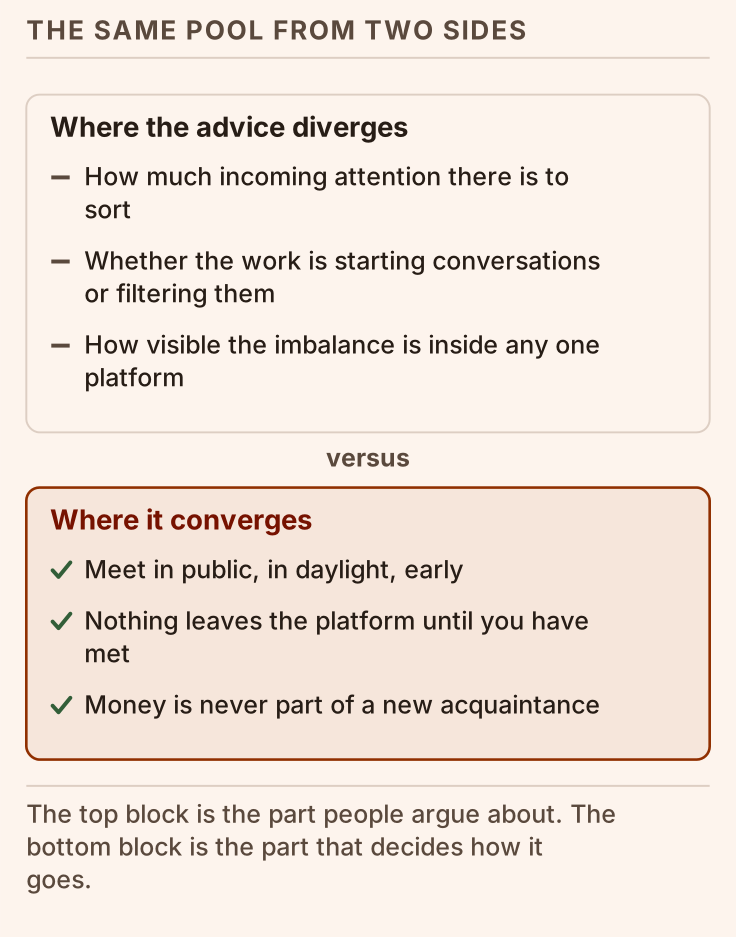
Calibrate the silence, too. Pew Research Center found in 2020 that three-quarters of single U.S. adults ages 65 and older are not looking for either a relationship or dates, so most non-replies are about the other person’s plans rather than about you. On the same note, Pew Research Center reported in 2023 that 14% of U.S. adults in their 60s say they have ever used an online dating platform — so the online pool is real, and it is a slice of the age group rather than all of it.
Every figure on this page, with its publisher, its year and the population it actually describes, is listed on the statistics page. If a number here has no entry there, it should not be on the page.
If something goes wrong, the reporting route runs in this order: use the platform’s own report or block function first, then the U.S. Federal Trade Commission at ReportFraud.ftc.gov and the FBI’s Internet Crime Complaint Center at ic3.gov. In Canada, the Canadian Anti-Fraud Centre takes reports at reportcyberandfraud.canada.ca or on 1-888-495-8501, Monday to Friday, 10 am to 4:45 pm Eastern. Routes verified September 8, 2026.
For the wider picture of what forms and how often at this age, see the odds of finding love after 60. For where people actually meet, see singles dating over 60. The rest of the editorial set sits on the dating in your 60s hub.
Are the numbered dating rules worth following?
Numbered dating rules are memory aids, not filters. The 7-7-7 rule, as it circulates, tells couples to have a date every seven days, a night away every seven weeks and a longer trip every seven months. It describes maintenance inside a relationship that already exists.
Its relatives do similar work: three-day and three-date rules invent a schedule for replies and physical contact that nobody agreed to, and they are usually cited by the person who wants the schedule to be binding.
Consider what a rule is actually for. Rules are useful in one narrow way — they give you a sentence to hold when you would otherwise drift. “New people get met in public first” is a rule worth keeping, because it protects something. “Wait three days before replying” protects nothing.
Judge a rule by what it prevents. If the answer is nothing, drop it.
Get the next check by email. We re-verify the reporting routes and re-read every page on a fixed schedule; the email list is where the updates go out. No affiliate links in it.